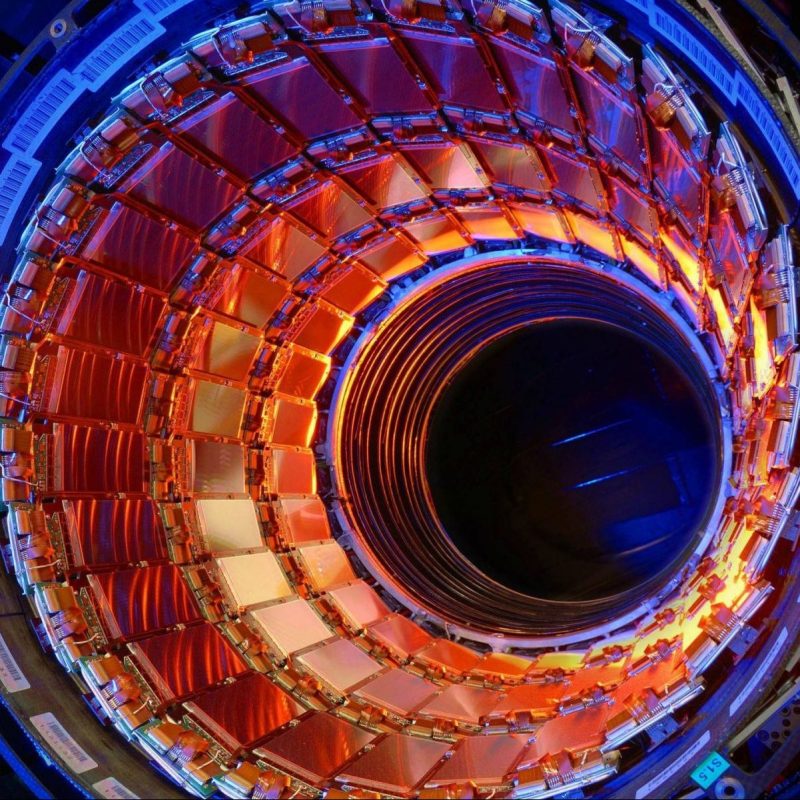
The goal of high-energy and particle theory research in the Center for Theoretical Physics (CTP) is to enable discoveries of physics beyond the Standard Model (BSM), both through precision tests of the Standard Model itself and through detailed studies of possible new phenomena. With the momentous discovery of the Higgs boson at the Large Hadron Collider in 2012, the Standard Model of particle physics is now complete, yet its shortcomings loom larger than ever. For example, the Standard Model cannot account for the nature and origin of dark matter, nor does it address the puzzling hierarchy between the electroweak and Planck scales. On cosmological scales, questions remain about what drives the accelerating expansion of the universe, both today and during the inflationary epoch.
For this reason, high-energy and particle theorists in the CTP are developing new theoretical frameworks to address physics in and beyond the Standard Model. The current effort in the CTP includes research that has a direct impact on experiments as well as research that pursues more formal theoretical directions. CTP researchers study possible new physics signatures at dark matter detection experiments, cosmological observatories, accelerators like the Large Hadron Collider, high intensity experiments, and small-scale table-top devices. At the same time, research in particle theory offers opportunities to push the boundaries of knowledge in quantum field theory (QFT), and innovations and creativity in QFT has long been a theme that unites the research conducted in the CTP.
The CTP has a long history of leadership in high-energy and particle theory. Emeritus faculty Dan Freedman, Jeffrey Goldstone, and Roman Jackiw are responsible for some of the fundamental theoretical ideas – especially those associated with symmetries and symmetry breaking – which lie at the heart of the Standard Model and its extensions. Frank Wilczek is one of the authors of the Standard Model and a pioneer in the study of axions and anyons, with long-standing interests in unification and supersymmetry. Eddie Farhi and Robert Jaffe have taken techniques developed in particle theory and applied them to the fields of quantum computation and fluctuation physics, respectively. Tracy Slatyer and Jesse Thaler represent the next generation of particle theorists, whose work draws on experimental and theoretical developments in areas ranging from dark matter detection to quantum chromodynamics to formal supergravity.
 Center for Fundamental Laws of Nature